Laser Kidney Stone Surgery (RIRS/PCNL): Procedure, Benefits, Disadvantages, Risks and Complications, Treatment options in Kolkata
Table of Contents
ToggleA Comprehensive Guide to ‘Laser Kidney Stone Surgery (RIRS/PCNL): Procedure, Benefits, Disadvantages, Risks and Complications, Treatment options in Kolkata′ by Dr. Debmalya Gangopadhyay, Consultant Urologist in Kolkata
Kidney stones, once a condition that required large, painful incisions and weeks of recovery, are now managed with extreme precision thanks to medical technology. In a city like Kolkata, where the hot and humid climate often leads to dehydration—a leading cause of stone formation—advanced urological care is more critical than ever.
If you are suffering from renal pain and looking for a Urologist in Kolkata, you have likely come across terms like RIRS and PCNL. This comprehensive 3,000-word guide will walk you through everything you need to know about Laser Kidney Stone Surgery (RIRS/PCNL) in Kolkata, helping you understand the procedures, the risks, and the benefits of modern “keyhole” and “scarless” treatments.
What is Laser Kidney Stone Surgery?
Laser surgery for kidney stones is a minimally invasive technique where a high-intensity laser beam (usually the Holmium:YAG laser) is used to break down stones into tiny fragments or “dust.” Unlike traditional surgeries, these procedures do not involve large cuts. Instead, they utilize natural body passages or tiny punctures to reach the stone directly.
The goal is simple: to achieve a “Stone-Free Rate” (SFR) that allows the patient to return to their normal life within days rather than weeks.
1. Retrograde Intrarenal Surgery (RIRS)
The “Scarless” Revolution
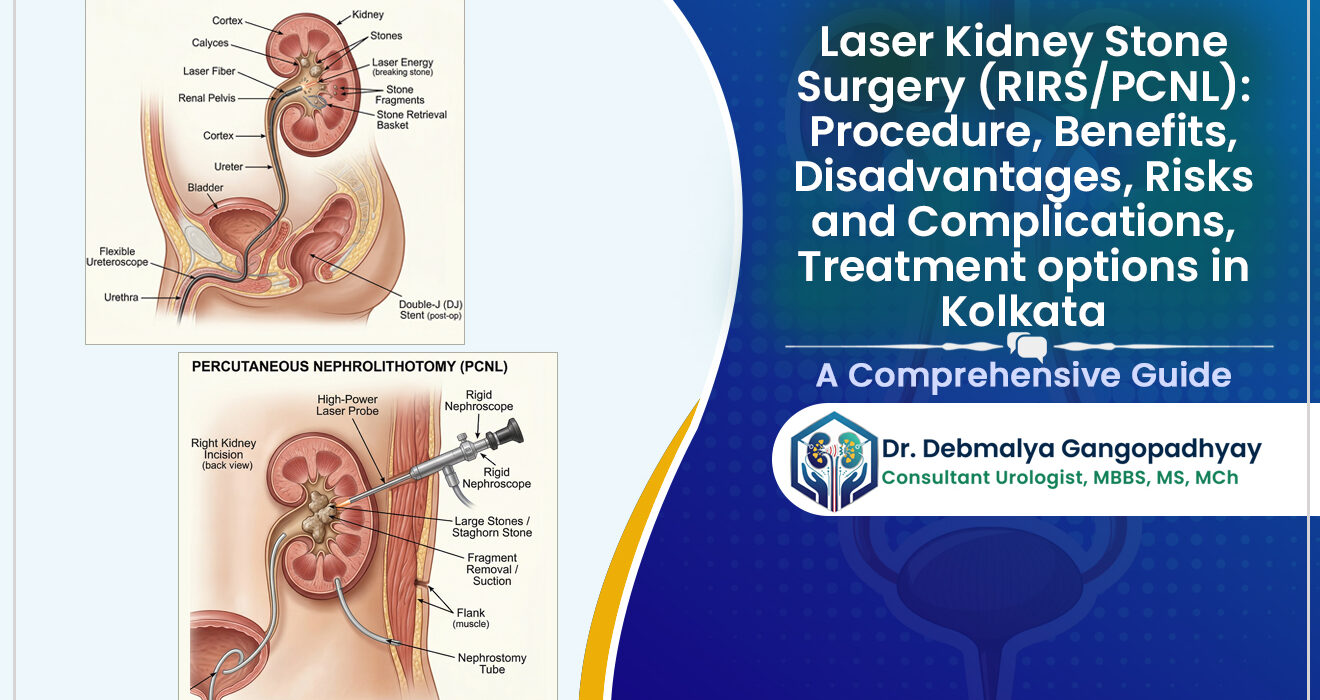
RIRS is often considered the pinnacle of modern urology. It is a “retrograde” procedure, meaning the surgeon enters through the natural urinary passage (urethra), moves through the bladder, and travels up to the kidney.
The RIRS Procedure Step-by-Step
- Anesthesia: The patient is placed under general anesthesia to ensure complete immobility and comfort.
- Scope Insertion: A Flexible Ureteroscope—a thin, fiber-optic tube with a camera—is inserted through the urethra.
- Navigation: The Urologist navigates the scope through the ureter and into the various “calyces” (chambers) of the kidney.
- Laser Fragmentation: Once the stone is located, a laser fiber (as thin as a hair) is passed through the scope. The laser energy pulverizes the stone into “dust” (Dusting technique) or small fragments (Fragmentation).
- Stone Removal: If fragments are large enough, a tiny nitinol basket is used to pull them out. If “dusted,” the remains pass out naturally with urine.
- DJ Stent Placement: A temporary Double-J (DJ) stent is usually placed in the ureter to ensure the pathway stays open while the internal lining heals.
Benefits of RIRS
- No Scars: There are absolutely no incisions on the skin.
- Rapid Recovery: Most patients go home the same day or the next morning.
- Minimal Pain: Since no muscle or skin is cut, post-operative pain is very low.
- High Success for Multiple Stones: The flexible scope can reach different corners of the kidney in one sitting.
Disadvantages of RIRS
- Size Limit: It is generally not recommended for stones larger than 2 cm.
- Technical Complexity: It requires a highly skilled Urologist in Kolkata with experience in flexible endoscopy.
2. Percutaneous Nephrolithotomy (PCNL)
The Gold Standard for Large Stones
For stones that are too large or too hard for RIRS, PCNL is the treatment of choice. It is a “keyhole” surgery performed through a tiny incision in the back.
The PCNL Procedure Step-by-Step
- Access: While the patient is under anesthesia, a small incision (approx. 1 cm) is made in the flank area.
- Track Creation: Using X-ray (C-arm) or Ultrasound guidance, a narrow tunnel is created from the skin directly into the kidney.
- Nephroscopy: A rigid or semi-rigid scope (Nephroscope) is inserted through the tunnel.
- Lithotripsy: The stone is broken using laser, ultrasonic, or pneumatic energy.
- Direct Extraction: Large pieces are physically removed through the tunnel, ensuring immediate clearance of the stone burden.
Benefits of PCNL
- Superior Clearance: The most effective way to clear “Staghorn” stones (stones that fill the entire kidney).
- Cost-Effective for Large Stones: Usually clears a 3 cm stone in one session, whereas RIRS might need two.
- Efficiency: Faster removal of high-volume stone material.
Disadvantages of PCNL
- Invasive: Involves a puncture through the kidney tissue.
- Hospital Stay: Requires 2-3 days of hospitalization.
- Visual Scar: A small, 1 cm scar will remain on the back.
Comparison: RIRS vs. PCNL
| Feature | RIRS | PCNL |
| Ideal Stone Size | < 2 cm | > 2 cm |
| Incision | None (Through natural passage) | 1 cm “Keyhole” in the back |
| Hospital Stay | 24 Hours | 48-72 Hours |
| Recovery | 2-3 Days | 7-10 Days |
| Risk of Bleeding | Negligible | Moderate (Puncture involved) |
Risks and Complications
While laser surgery is safer than old-fashioned open surgery, no medical procedure is without risk. Your Urologist in Kolkata will discuss these with you before the operation.
General Risks
- Infection (UTI): Bacteria trapped in the stone can be released during fragmentation. Antibiotics are given to prevent this.
- Hematuria: Blood in the urine for a few days is expected.
- Fever: A mild post-operative fever is common as the body reacts to the procedure.
Specific Risks for RIRS
- Ureteral Injury: The delicate lining of the ureter can sometimes be irritated or abraded.
- Stent Syndrome: The DJ stent can cause a frequent urge to urinate or mild discomfort in the bladder area.
Specific Risks for PCNL
- Bleeding: The kidney is a very vascular organ; occasionally, significant bleeding may occur requiring a blood transfusion.
- Injury to Nearby Organs: In very rare cases, the colon or pleura (lung lining) can be affected by the puncture.
Treatment Options and Availability in Kolkata
Kolkata has emerged as a hub for advanced urology in Eastern India. From world-class private hospitals to specialized clinics, the city offers high-end technology including:
- 100-Watt Holmium Lasers: For faster stone “dusting.”
- Digital Flexible Scopes: For crystal-clear visualization during RIRS.
- Mini-PCNL: A variation of PCNL using even smaller instruments (approx. 3-4 mm) to reduce pain and bleeding.
When searching for a Urologist in Kolkata, it is vital to choose a surgeon who is proficient in both RIRS and PCNL so they can recommend the best option based on your specific stone characteristics rather than their personal equipment limitations.
10+ Search-Based FAQs on Laser Kidney Stone Surgery
1. Is laser kidney stone surgery painful?
The surgery itself is performed under anesthesia, so you feel nothing. Post-surgery, RIRS patients feel very little pain, while PCNL patients may feel soreness at the incision site for a few days.
2. How long does the laser surgery take?
A typical RIRS or PCNL procedure takes between 45 to 90 minutes.
3. Can I walk after laser surgery?
Yes. For RIRS, patients are usually walking within 6 hours. For PCNL, patients are encouraged to walk within 24 hours to prevent blood clots.
4. What is the success rate of RIRS in Kolkata?
In expert hands, the success rate for stones under 2 cm is over 90-95%.
5. Will I need a second surgery?
If the stone is very large (e.g., > 3 cm) or if there are multiple stones in different parts of the kidney, a second stage may occasionally be planned to ensure complete clearance.
6. Is a DJ Stent mandatory?
In most laser surgeries, a stent is placed to prevent the ureter from swelling shut. It is usually removed in the clinic after 1-2 weeks.
7. Can kidney stones come back after laser surgery?
The surgery removes existing stones, but it doesn’t change your body’s chemistry. Without dietary changes and high water intake, there is a 50% chance of recurrence within 5-10 years.
8. Is laser surgery covered by health insurance?
Yes, RIRS and PCNL are standard-of-care procedures and are covered by almost all major health insurance providers and TPAs in Kolkata.
9. How soon can I return to work?
RIRS patients can often return to office work in 3 days. PCNL patients may require 7 to 10 days before returning to a full work schedule.
10. What are the signs of a kidney stone that needs surgery?
Intense flank pain, persistent nausea, blood in the urine, and recurrent urinary infections are signs that a stone is causing an obstruction and needs surgical attention.
11. Why is the cost of laser surgery higher than ESWL?
Laser surgery (RIRS/PCNL) involves expensive disposable equipment, high-end laser machines, and operating room costs, but it offers a much higher “one-and-done” success rate compared to shockwave therapy (ESWL).
Conclusion: Take the Step Toward a Stone-Free Life
Living with kidney stones is not just about the pain; it is about the risk of permanent kidney damage caused by chronic obstruction. Laser Kidney Stone Surgery (RIRS/PCNL) in Kolkata offers a pathway to recovery that is fast, safe, and highly effective.
Whether you need the “scarless” precision of RIRS or the “stone-clearing” power of PCNL, consulting an experienced Urologist in Kolkata is the first step. Modern medicine has ensured that “the knife” is no longer the only answer—the laser is here to provide a better, brighter, and pain-free tomorrow.
Disclaimer: This blog is for informational purposes only. Always consult a qualified medical professional for diagnosis and treatment.
FAQ's on Laser Kidney Stone Surgery (RIRS/PCNL)
What is laser kidney stone surgery, and how do RIRS and PCNL differ?
Laser kidney stone surgery uses concentrated light beams to break stones into dust or passable fragments. RIRS (Retrograde Intrarenal Surgery) is a completely incision-less procedure where a flexible scope is passed through the urethra and bladder up into the kidney to laser the stone. PCNL (Percutaneous Nephrolithotomy) is used for larger stones and involves making a tiny "keyhole" puncture in the back to directly access the kidney and crush the stones.
What are the main benefits of laser surgery for kidney stones?
The primary benefits include a minimally invasive approach with no major cuts, resulting in significantly less bleeding and post-operative pain. Patients typically experience a much faster recovery, shorter hospital stays (often discharged within 24 to 48 hours), high success rates for complete stone clearance, and minimal risk of damage to surrounding kidney tissue.
What are the disadvantages, risks, and possible complications of RIRS and PCNL?
While generally safe, risks include urinary tract infections (UTIs) or sepsis, minor bleeding, and the potential for residual stone fragments that may require a secondary procedure. A temporary Double-J (DJ) stent is often placed after RIRS, which can cause mild discomfort and frequent urination until removed. PCNL carries a slightly higher risk of bleeding or injury to adjacent organs due to the percutaneous tract.
What are the treatment options for laser kidney stone surgery in Kolkata?
Kolkata is highly equipped with advanced urological facilities offering both traditional and cutting-edge treatments like Mini-PCNL and Holmium/Thulium laser RIRS. Top-tier hospitals such as Apollo Multispeciality Hospitals, Medica Superspecialty Hospital, AMRI Hospitals, and Fortis Hospital feature specialized stone clinics and experienced endourologists providing comprehensive, state-of-the-art stone management.
Don’t wait for the condition to worsen. Expert reconstructive care is the key to a healthier, more confident future.
Disclaimer: This article is for informational purposes only and does not constitute medical advice. Always consult with a qualified cardiac specialist for diagnosis and treatment related to your personal health condition.
Read Also:
- Why You Need a Laparoscopic Urologist in Kolkata for Kidney Care
- Reconstructive Urology Specialist Doctor in Kolkata: Procedure & Area of Treatment Options
- Understanding Modern Reconstructive Urology Treatments: Procedure, Benefits, Disadvantages, Risks and Complications, Treatment options in Kolkata
- The Evolution of Advanced Robotic and Laparoscopic Urology Surgery
- What the Color of Your Urine Says About Your Health: A Comprehensive Guide
- Most common urological problems in India in 2026
- A Comprehensive Guide to Blood in Urine (Hematuria): Causes, Diagnosis & Treatment in Kolkata 2026
- What is the difference between a nephrologist and a urologist
- 10 Common Urology Procedures treated by a urologist