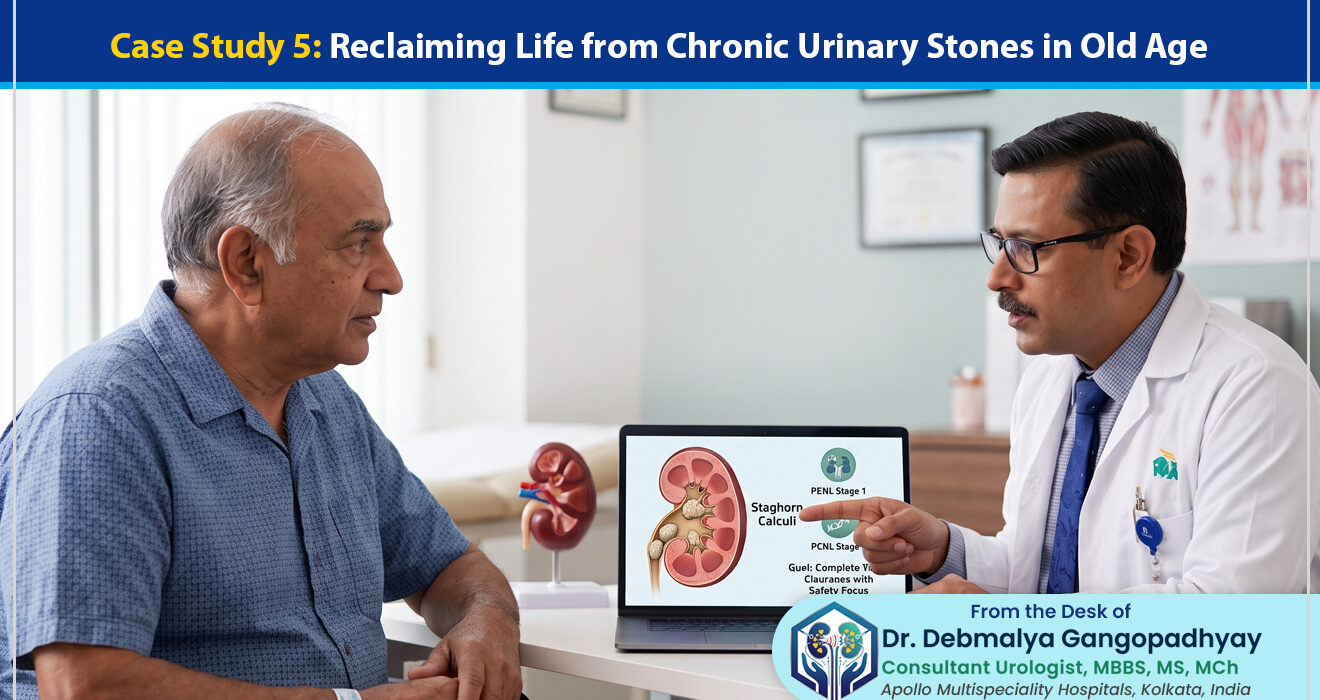
Case Study 5: Reclaiming Life from Chronic Urinary Stones in Old Age
‘Case Study 5: Reclaiming Life from Chronic Urinary Stones in Old Age’ – from the desk of Dr. Debmalya Gangopadhyay, Senior Consultant Urologist, Apollo Multispeciality Hospitals, Kolkata, India
When most people think of kidney stones, they imagine an abrupt, agonizing pain that sends them rushing to the emergency room in the middle of the night. While that is the reality for small, traveling stones, there is a much quieter—and far more dangerous—version of this disease. It is a silent condition that gradually drains a person’s energy and independence, particularly in older adults.
This is the reality of the “staghorn” calculus.
For elderly individuals already managing diabetes, high blood pressure, or a fragile heart, the thought of major surgery can be terrifying. Many choose to suffer in silence, relying heavily on painkillers and watching their quality of life fade. As urologists, our goal is to bridge the gap between cutting-edge surgical technology and safe, compassionate patient care.
Below is the step-by-step journey of a 70-year-old patient who successfully battled a massive kidney stone to regain his mobility. Whether you are seeking care for yourself or an aging parent, understanding this modern approach to urinary stone management will help you make informed, confident health decisions.
Part 1: Understanding the Threat – What is a Staghorn Stone?
Kidney stones vary wildly in size and composition. While most are small pebbles made of calcium or uric acid, a staghorn stone is entirely different.
How They Grow Imagine the inside of a kidney as a cavern with smaller branching tunnels that funnel urine down toward the bladder. A staghorn calculus grows so large that it fills this entire cavern, branching out like the antlers of a deer (hence the name).
These are typically “infection stones” made of a mineral called struvite. They form when specific bacteria infect the urinary tract and alter the urine’s chemistry, creating an alkaline environment where these massive stones can crystallize and grow at an alarming rate.
The Hidden Danger Because they sit stationary in the spacious part of the kidney, staghorn stones can initially be painless. But this silence is deceptive. As they expand, they:
- Act as Bacterial Fortresses: The stone itself harbors bacteria, making the infection impossible to cure with standard antibiotics.
- Crush the Kidney: The sheer bulk of the stone slowly destroys the kidney’s delicate filtering tissues.
- Risk Life-Threatening Sepsis: If left untreated, the bacteria can spill into the bloodstream, causing a fatal whole-body infection.
Treating a staghorn isn’t just about pain relief; it is about saving the kidney and preserving the patient’s life.
Part 2: Meeting the Patient
To understand how this looks in real life, let me introduce you to “Mr. Ramesh” (name changed for privacy), a 70-year-old retired school principal.
Over three years, his family watched his health steadily decline. Once an avid walker, a constant, heavy ache in his right lower back eventually confined him to a recliner. He battled recurring fevers and chills. Local doctors would treat these as routine UTIs with antibiotics, but the fevers always returned. The chronic pain and fatigue destroyed his appetite, leaving him frail and sedentary.
Adding to the complexity, Mr. Ramesh had Type 2 diabetes, high blood pressure, and a history of heart issues that required blood thinners.
The breaking point occurred when his urine became cloudy, foul-smelling, and tinged with blood. Utterly exhausted and needing help just to walk to the bathroom, his family brought him to our clinic at Apollo Multispeciality Hospitals. When I examined him, tapping gently over his right kidney caused him to wince in deep pain. I explained to him and his son that this wasn’t just “old age”—it was a structural issue inside his kidney that we needed to uncover.
Part 3: The Diagnostic Blueprint
When treating older patients with complex medical histories, guesswork is not an option.
Step 1: Blood and Urine Testing
His urine was full of pus and red blood cells, and the culture revealed a specific bacteria (Proteus mirabilis) known for creating staghorn stones. His blood tests showed active infection, mild anemia, struggling kidney function (elevated creatinine), and poorly controlled blood sugar.
Step 2: Imaging
An initial ultrasound showed his right kidney was swollen with fluid and hiding a massive shadow. We immediately ordered a Non-Contrast CT scan—the gold standard for stone diagnosis.
The CT scan was undeniable: Mr. Ramesh had a staggering 6.5 cm by 4 cm complete staghorn stone. It had molded perfectly to the inside of his kidney, blocking everything and beginning to thin out the healthy kidney tissue.
I showed the 3D scans to the family, comparing the massive stone to a large piece of ginger completely clogging his internal plumbing. It was the root cause of his misery, but thankfully, it was highly treatable.
Part 4: A Modern Surgical Strategy
Operating on a 70-year-old diabetic patient with a cardiac history requires incredible precision. Extended time under general anesthesia, the risk of bleeding, and the potential for a massive bacterial release (sepsis) during surgery meant we had to prioritize safety without compromising on the results.
Historically, patients with complete staghorn stones had to undergo outdated open surgeries or multiple “staged” procedures, requiring them to endure several painful punctures through their back over a period of weeks.
Today, my approach is different. I generally clear these stones, even complete staghorns, in a single first attempt. Staged PCNL is no longer my preferred choice.
The Procedure: Single-Attempt PCNL
We opted for a Percutaneous Nephrolithotomy (PCNL). After a week of aggressively optimizing his blood sugar, managing his blood pressure, and starting targeted antibiotics, we took Mr. Ramesh into the operating room.
Under anesthesia, we created a tiny, pen-width tunnel through his back directly into the kidney. Using a specialized camera and a high-power Holmium Laser, we efficiently shattered the massive struvite stone into dust and vacuumed it out. Working with speed and precision, we achieved full clearance in a single, streamlined session.
The RIRS Safety Net
The reason we can confidently abandon staged back-puncture surgeries is the advent of RIRS (Retrograde Intrarenal Surgery). If a patient has a complex staghorn and a stubborn fragment is left hiding in a hard-to-reach pocket after the initial PCNL, we can simply use RIRS at a later date. RIRS utilizes an ultra-thin, flexible camera passed naturally through the urinary tract, allowing us to laser away leftover fragments with zero incisions.
For Mr. Ramesh, the single-attempt PCNL was completely successful. We finished by leaving a soft, internal Double-J (DJ) Stent in his ureter to help the kidney heal and allow any remaining microscopic dust to wash out naturally.
Part 5: Recovery and Follow-Up
Because the procedure only required a half-inch puncture, Mr. Ramesh’s surgical pain was remarkably low. By that evening, he was sitting up in a chair and eating a normal diet. He was discharged on day three, completely free of his massive stone burden.
We sent him home with strict instructions to maintain excellent hydration (up to 3 liters a day) and monitor his blood sugar closely.
The Results Three weeks later, he returned for a simple, two-minute outpatient procedure to remove the internal DJ stent.
By his three-month checkup, the transformation was staggering. His urine was completely sterile. His kidney function had dramatically improved, dropping to healthy creatinine levels, and his ultrasound showed a healthy, stone-free kidney. Because lab tests confirmed the stone was caused by an infection, we placed him on a specific low-dose antibiotic and a citrate-rich diet to ensure it never returned.
Six months post-surgery, Mr. Ramesh walked into my office unassisted, carrying a box of sweets. The chronic ache was gone. He was back to walking two kilometers a day, his diabetes was easier to manage, and he was finally able to play with his grandchildren without pain. We didn’t just remove a rock; we gave a man his life back.
Part 6: Frequently Asked Questions
1. Can medicines or herbal treatments dissolve a large staghorn stone?
No. This is a dangerous myth. While tiny uric acid stones can sometimes be medically managed, massive infection stones cannot be dissolved by syrups or medications. Trying to do so only delays life-saving surgery.
2. I have a large stone but no pain. Is it safe to ignore it?
Absolutely not. Large staghorn stones are often painless because they sit in the open space of the kidney, but they silently destroy the surrounding tissue and harbor dangerous, life-threatening bacteria.
3. Why do you avoid "Staged PCNL" for massive stones?
In the past, massive stones required multiple back-puncture surgeries spaced days apart. Today, we strive to clear the stone entirely on the first attempt. If a tiny fragment is unreachable, we can use RIRS later—a technique that requires zero incisions—saving the patient from undergoing a second traumatic puncture through their back.
4. What is a DJ Stent?
It is a temporary, soft plastic tube placed inside the urinary tract at the end of surgery. It helps the kidney heal without swelling and allows microscopic stone dust to pass easily. It is painlessly removed a few weeks later in the clinic.
5. How do I prevent kidney stones from coming back?
Hydration is key—drink 2.5 to 3 liters of water daily. Maintain a normal calcium intake, heavily restrict your salt (sodium), incorporate citrus fruits (like lemons) into your diet, and limit excessive animal protein.
6. Does diabetes increase my risk for kidney stones?
Yes. Type 2 diabetes makes your urine highly acidic, which invites uric acid stones. It also makes you more prone to urinary tract infections, which are the leading cause of massive struvite staghorn stones.
Read Also:
- Case Study 1: Overcoming Complex Kidney Stones-A Successful RIRS Procedure
- Case Study 2- Life After Prostate Cancer: Successful Uro-Oncology Management
- Case Study 3: Minimally Invasive Relief: Treating Advanced BPH with Laparoscopic Surgery
- Case Study 4: Restoring Function – A Case of Reconstructive Urology for Urethral Stricture
- Case Study 6: Rapid Recovery – Robotic-Assisted Surgery for Renal Cell Carcinoma (Kidney Cancer)
Disclaimer: The information in this case study is intended for educational purposes and does not replace professional medical advice. Patient details have been altered to protect privacy. Surgical outcomes vary by individual. If you are experiencing symptoms of urinary stone disease, please consult a qualified urologist for a personalized diagnosis and treatment plan.