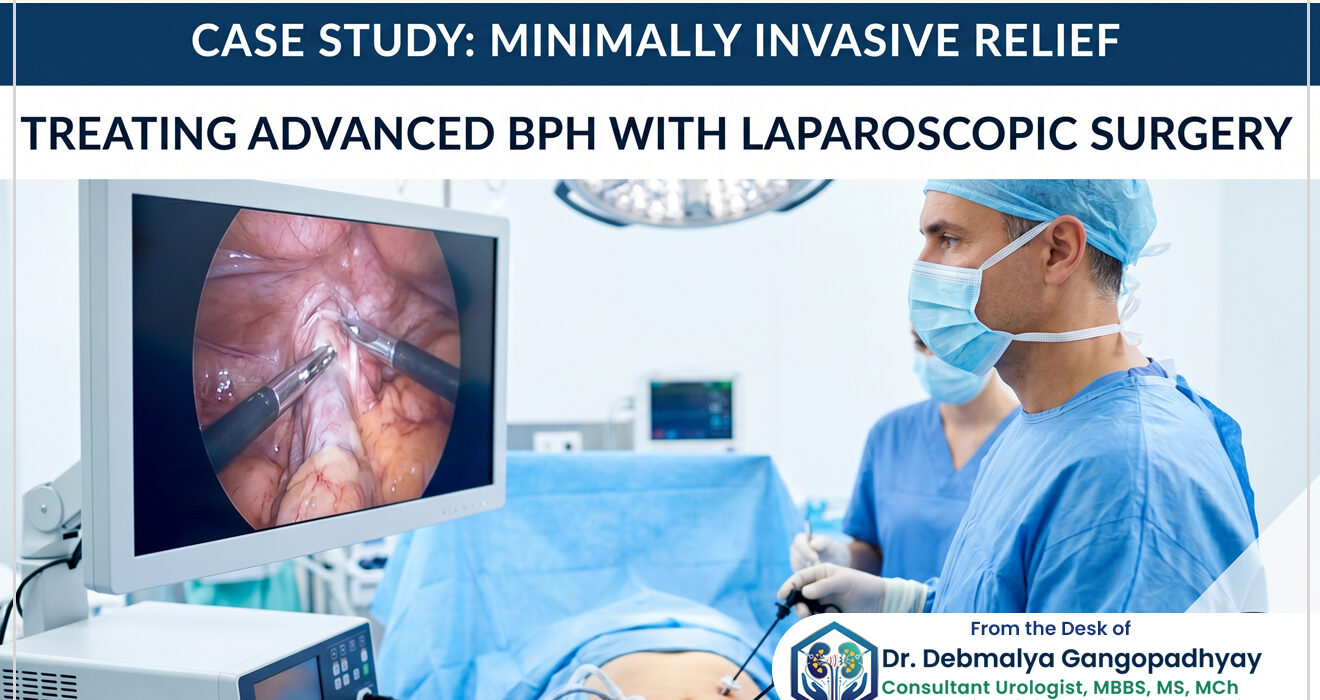
Case Study 3: Minimally Invasive Relief: Treating Advanced BPH with Laparoscopic Surgery
Table of Contents
Toggle‘Case Study 3: Minimally Invasive Relief: Treating Advanced BPH with Laparoscopic Surgery’ – from the desk of Dr. Debmalya Gangopadhyay, Senior Consultant Urologist, Apollo Multispeciality Hospitals, Kolkata, India
Introduction: The Silent Struggle of Aging Men
Aging is a natural, beautiful process that brings wisdom, experience, and the joy of watching families grow. However, it also brings physiological changes that can sometimes severely impact a person’s quality of life. For millions of men around the world, one of the most common, yet least talked about, challenges of aging is the enlargement of the prostate gland.
Often dismissed as just “getting older” or “a weak bladder,” the reality of living with an enlarged prostate can be exhausting. It dictates schedules, interrupts sleep, and can eventually lead to severe medical emergencies. But it doesn’t have to be this way. Modern medicine has evolved dramatically, shifting away from massive, painful open surgeries toward sleek, minimally invasive techniques that offer rapid relief and quick recovery.
This comprehensive, step-by-step case study is designed for patients and their families. It aims to demystify Benign Prostatic Hyperplasia (BPH) by walking you through a real-life medical journey. We will explore how an elderly patient, suffering from extreme urinary blockages, found lasting relief through advanced laparoscopic surgery. By humanizing the medical jargon and breaking down the complex procedures into simple, everyday language, we hope to provide education, comfort, and most importantly, hope for those facing similar struggles.
Understanding the Prostate: The Body’s Plumbing System
To truly understand the problem, we first need to understand the anatomy. Imagine your urinary system as a simple plumbing network. You have a storage tank (the bladder) and a pipe that carries the water out of the house (the urethra).
The prostate is a small, walnut-sized gland that is unique to men. It sits directly beneath the bladder. Crucially, the urethra (the exit pipe) runs right through the very center of the prostate gland, much like a train running through a tunnel.
The prostate’s primary job is reproductive; it produces the fluid that nourishes and protects sperm. However, as men enter their 50s, 60s, and beyond, the prostate naturally begins to grow. This non-cancerous growth is known as Benign Prostatic Hyperplasia, or BPH.
For many men, this growth happens outward and causes no issues. But for others, the prostate grows inward, squeezing the “tunnel” (the urethra) tighter and tighter. Imagine stepping on a garden hose while water is trying to flow through it. The water flow slows to a trickle, pressure builds up behind the blockage, and eventually, the system struggles to function. This is exactly what happens in advanced BPH. The bladder has to work overtime to push urine past the blockage, leading to a host of frustrating and sometimes dangerous symptoms.
Patient Background and Initial Assessment
Meet Mr. Chatterjee: A Life Governed by Symptoms
Let us introduce you to our patient, Mr. Chatterjee (name changed to ensure absolute patient confidentiality). Mr. Chatterjee is a 72-year-old retired civil engineer who resides in a bustling neighborhood in Kolkata. He has always been a man of structure and routine. In his retirement, he found immense joy in taking his grandchildren to the local parks, attending evening cultural programs, and enjoying long, uninterrupted road trips with his wife.
However, over the past four years, Mr. Chatterjee’s vibrant lifestyle began to shrink, dictated entirely by his bladder.
It started innocently enough. He noticed his urine stream wasn’t as strong as it used to be. Then came the hesitancy—standing in the restroom for a minute or two before the flow would actually begin. Gradually, the situation worsened. He began waking up three, then four, and sometimes five times a night with a desperate urge to urinate, only to pass a small, unsatisfying amount.
During the day, the urgency became overwhelming. He stopped taking road trips because he couldn’t go more than an hour without finding a restroom. He avoided theaters and social gatherings, terrified of not making it to the toilet in time. His world had become incredibly small, overshadowed by chronic sleep deprivation and constant anxiety.
The Breaking Point: Acute Urinary Retention (AUR)
Like many stoic elderly men, Mr. Chatterjee suffered in silence, believing this was his cross to bear as an old man. He tried adjusting his fluid intake, avoiding water after 6 PM, but nothing worked.
The breaking point arrived one frightening evening. After a family dinner, Mr. Chatterjee felt an intense, agonizing urge to urinate. He went to the restroom, but nothing happened. Not a single drop. His bladder was completely full, stretching his abdomen and causing excruciating lower belly pain.
He was experiencing Acute Urinary Retention (AUR)—a medical emergency where the prostate has completely pinched the urethra shut, trapping the urine inside the bladder.
Panicked and in immense pain, his family rushed him to the emergency room at Apollo Multispeciality Hospitals in Kolkata. The immediate initial assessment by the emergency duty doctor confirmed a massively distended bladder.
The Immediate Relief: Catheterization
To relieve the immense pressure and prevent permanent damage to his kidneys (which can occur if urine backs up from the bladder into the kidneys), the medical team had to perform immediate catheterization.
A Foley catheter—a soft, flexible, sterile tube—was gently pushed through his urethra, past the obstructive prostate, and into the bladder. The relief was instantaneous. Over a liter of trapped, dark urine was drained immediately. While the pain was gone, the underlying problem remained massive. Mr. Chatterjee was sent home the next morning with the catheter bag attached to his leg, instructed to follow up immediately with a specialized urologist.
Diagnostic Process and Confirmation
The Urological Consultation
A few days later, Mr. Chatterjee and his anxious family sat in the consultation room. The presence of the catheter bag was a constant, uncomfortable reminder of his condition. The goal of this consultation was to comprehensively map out the size of the problem and confirm that the enlargement was strictly benign (non-cancerous).
To explain the situation clearly, the specialist walked Mr. Chatterjee through a step-by-step diagnostic roadmap. There is no guessing in modern uro-oncology and urology; every decision is backed by precise data.
Step 1: Comprehensive Medical History and Symptom Scoring
The first step was a detailed conversation. The doctor used the International Prostate Symptom Score (IPSS) questionnaire. This is a standardized tool that asks patients to rate the severity of their symptoms on a scale. Given his recent history of acute retention, severe nocturia (nighttime urination), and weak stream, Mr. Chatterjee scored in the “Severe” category.
The doctor also reviewed his medical history. Mr. Chatterjee was mildly diabetic and had mild hypertension, both of which were well-controlled with medication. This information was crucial for planning any future surgical interventions.
Step 2: Blood Tests and Prostate-Specific Antigen (PSA)
Because an enlarged prostate can sometimes mimic the symptoms of prostate cancer, ruling out malignancy is the absolute highest priority.
- Renal Function Test: Blood was drawn to check his creatinine and urea levels. This ensures that the severe backup of urine had not caused any long-term damage to his kidneys. Thankfully, his kidney function was normal.
- PSA Test: Prostate-Specific Antigen (PSA) is a protein produced by the prostate. High levels can indicate inflammation, extreme enlargement, or cancer. Mr. Chatterjee’s PSA was moderately elevated at 6.5 ng/mL. While slightly high, it was consistent with a massively enlarged gland rather than cancer, but it required careful correlation with imaging.
Step 3: Advanced Imaging – Ultrasound (KUB) and TRUS
To literally “see” the problem, non-invasive imaging was used. An Ultrasound of the Kidneys, Ureters, and Bladder (KUB) was performed. The ultrasound technician scanned his abdomen. The results were startling but explanatory.
A normal, healthy prostate weighs roughly 20 to 25 grams. Mr. Chatterjee’s ultrasound revealed a massively enlarged prostate weighing 135 grams.
Furthermore, a Transrectal Ultrasound (TRUS) was conducted to get a highly detailed, close-up look at the prostate tissue to ensure there were no suspicious nodules or hard spots that might suggest cancer. The gland was found to be uniformly enlarged, pushing aggressively upward into the floor of the bladder, acting like a giant boulder blocking a doorway.
The diagnosis was crystal clear: Severe Benign Prostatic Hyperplasia (BPH) with a massive adenoma, leading to acute urinary retention.
The Failure of Medical Therapy
Why Pills Were No Longer the Answer
When patients are diagnosed with BPH, the first line of defense is almost always medical management—prescription pills. It is important to understand why Mr. Chatterjee had reached a stage where pills were no longer a viable long-term solution.
During the consultation, it was revealed that Mr. Chatterjee had been prescribed medications by his local general physician two years prior. He had been taking a combination of two common drugs:
- Alpha-Blockers (like Tamsulosin): These drugs do not shrink the prostate. Instead, they act as muscle relaxants, loosening the smooth muscle fibers around the prostate and the neck of the bladder, hoping to open the “tunnel” a little wider for urine to flow.
- 5-Alpha Reductase Inhibitors (like Finasteride or Dutasteride): These drugs actually aim to shrink the prostate by blocking the hormone (DHT) that causes prostate growth.
While these pills often work wonders for men with mild to moderate enlargement (prostates weighing 40-60 grams), they have physical limits.
For Mr. Chatterjee, his prostate had grown so massive (135 grams) that no amount of muscle relaxation could open the blocked channel. Furthermore, the shrinking drugs (Finasteride) take many months to show even a slight reduction in size, and they rarely shrink a gland of that magnitude enough to resolve an acute blockage.
Additionally, prolonged use of the catheter was not an option. Living permanently with a tube in the bladder drastically increases the risk of severe, life-threatening urinary tract infections (UTIs), bladder stones, and psychological distress.
The medical therapy had definitively failed. The blockage was purely mechanical—a massive physical obstruction—and therefore, it required a mechanical, surgical solution.
Line of Treatment: Choosing the Minimally Invasive Path
Evaluating the Surgical Options
Hearing the word “surgery” is inherently terrifying for an elderly patient. Mr. Chatterjee’s immediate fear was a large cut on his abdomen, weeks of bed rest, and the potential complications of a major operation at the age of 72.
The medical team sat down with the family to map out the surgical options. In urology, the size of the prostate dictates the surgical approach.
Option 1: TURP (Transurethral Resection of the Prostate)
This is the most common prostate surgery worldwide. It involves passing an instrument through the tip of the penis, up the urethra, and scraping away the inside of the prostate to widen the channel.
- The Problem: TURP is excellent for small to medium prostates (up to 60-80 grams). However, for a massive 135-gram prostate like Mr. Chatterjee’s, a TURP would take too long, leading to excessive bleeding and a high risk of fluid absorption complications (TUR syndrome). It was ruled out.
Option 2: Open Simple Prostatectomy
Historically, this was the gold standard for massive prostates. It involves making a large, 6-to-8-inch surgical incision across the lower abdomen, cutting open the bladder, and physically scooping out the massive prostate adenoma with the surgeon’s fingers.
- The Problem: While highly effective at clearing the blockage, it is a highly invasive, painful procedure. It requires a long hospital stay, carries a high risk of significant blood loss requiring transfusions, and demands a slow, painful recovery at home for several weeks.
Option 3: Laparoscopic Simple Prostatectomy
This is where the pinnacle of modern surgical technology comes into play. It achieves the exact same excellent results as the open surgery, but without the large, painful incision.
The Laparoscopic Advantage
The specialist strongly recommended a Laparoscopic Simple Prostatectomy.
Here is how it was explained to Mr. Chatterjee to ease his fears: Instead of making a large cut to put his hands inside the body, the surgeon would make three to four tiny “keyhole” incisions (each smaller than a fingernail) on his abdomen.
Through one keyhole, a high-definition, magnified 3D camera is inserted, projecting the inside of the pelvis onto a large television screen in the operating room. Through the other keyholes, the surgeon uses specialized, long, pencil-thin instruments. Watching the screen, the surgeon carefully opens the capsule of the prostate and removes the massive obstructing tissue entirely from the inside, placing it in a surgical retrieval bag, and pulling it out through one slightly widened keyhole.
Why this was the perfect choice:
- Minimal Blood Loss: The extreme magnification of the camera allows the surgeon to see and seal tiny blood vessels instantly, minimizing bleeding.
- Less Pain: Smaller incisions mean significantly less post-operative pain.
- Faster Recovery: Patients can walk the next day and are discharged much quicker than with open surgery.
- No Limits on Size: It effortlessly handles massive prostates that are too large for standard TURP.
Comforted by the logic, the safety profile, and the promise of a faster return to his normal life, Mr. Chatterjee confidently chose the laparoscopic approach.
The Surgical Experience: Inside the Operating Room
Pre-Operative Preparations
Because Mr. Chatterjee was 72 with mild diabetes, meticulous pre-operative preparation was necessary. The anesthesia team evaluated his cardiovascular health to ensure he was fit for general anesthesia. His blood sugar levels were strictly managed in the days leading up to the procedure to optimize his body for healing.
The Day of the Surgery
On the morning of the operation, Mr. Chatterjee was brought into the state-of-the-art operating theater. He was placed under general anesthesia, ensuring he was completely asleep, safe, and feeling absolutely no pain.
The surgical team proceeded with the Laparoscopic Simple Prostatectomy:
- Creating the Workspace: The abdomen was gently inflated with a harmless carbon dioxide gas. This creates a “dome” or a working tent inside the belly, giving the surgeon ample room to maneuver the instruments safely without touching the intestines.
- Accessing the Prostate: The keyhole incisions were made. The camera provided a crystal-clear, magnified view of the bladder and the massively enlarged prostate bulging beneath it.
- Removing the Blockage (The Adenoma): Using precision ultrasonic shears, the surgeon carefully opened the outer shell (the capsule) of the prostate. Just like peeling an orange to extract the fruit inside while leaving the rind intact, the surgeon carefully separated the massive, overgrown, obstructing tissue (the adenoma) from the healthy outer capsule.
- Extraction: The massive 135-gram tissue was completely freed, placed into a sterile plastic retrieval bag inside the abdomen, and safely extracted through the umbilical (belly button) keyhole.
- Reconstruction: With the blockage gone, a massive, wide-open channel was left behind. The surgeon meticulously stitched the prostate capsule back together. A new, temporary urinary catheter was placed to allow the newly widened channel to heal properly.
- Closure: The gas was deflated, and the tiny keyhole incisions were closed with a few absorbable stitches and covered with waterproof band-aids.
The entire surgery took approximately two and a half hours. The blood loss was so minimal that no blood transfusions were required—a massive victory compared to traditional open surgery.
Post-Operative Care and The Road to Discharge
Waking Up and Immediate Recovery
Mr. Chatterjee woke up in the post-anesthesia care unit. He was groggy but was pleasantly surprised to find that the severe abdominal pain he had feared was completely absent. He only felt a mild, dull ache around his belly button, which was easily controlled with standard, mild painkillers.
Because laparoscopy avoids cutting through large abdominal muscles, his mobility was preserved. By the very next morning, under the encouraging guidance of the ward nurses, Mr. Chatterjee was sitting up in a chair and eating a normal breakfast. By the afternoon, he was taking short, assisted walks down the hospital corridor.
This early mobilization is a hallmark of laparoscopic surgery. It drastically reduces the risk of post-operative complications like deep vein thrombosis (blood clots in the legs) and pneumonia.
The Discharge
After just three days in the hospital—a fraction of the time required for open surgery recovery—Mr. Chatterjee was deemed fit for discharge. He was sent home with his urinary catheter still in place. The internal surgical wounds needed a few more days to heal without the pressure of urine passing over them. He was given a short course of oral antibiotics and precise instructions on how to manage the catheter bag at home.
Follow-Up and Rehabilitation
The Milestone: Catheter Removal
Exactly seven days after the surgery, Mr. Chatterjee returned to the outpatient clinic for the most anticipated moment of his journey: the removal of the catheter.
The procedure was quick and painless. The doctor gently removed the tube. Now came the true test. Mr. Chatterjee was asked to drink plenty of water and wait until his bladder felt full.
An hour later, he walked into the clinic’s restroom. For the first time in years, he experienced a strong, continuous, effortless flow of urine. There was no hesitation, no straining, and most importantly, a profound feeling that his bladder was finally, completely empty. The mechanical blockage had been completely eradicated.
Managing Temporary Incontinence
The doctor had thoroughly prepared Mr. Chatterjee for the next phase. When a massive prostate is removed, the urinary sphincter (the muscle valve that holds urine in) has to adjust to the new, wide-open channel. It is entirely normal to experience some temporary urinary urgency or mild leakage, especially when coughing or sneezing, in the first few weeks after the catheter is removed.
To rehabilitate his pelvic muscles, Mr. Chatterjee was instructed to perform Kegel exercises daily. These exercises strengthen the pelvic floor. By his four-week follow-up appointment, his muscle tone had completely recovered, and any mild leakage had completely vanished.
Success: A Life Reclaimed
The Long-Term Impact
Today, six months post-surgery, Mr. Chatterjee’s life is unrecognizable compared to the nightmare of his acute urinary retention.
The pathology report of the removed 135-gram tissue confirmed it was entirely benign—no cancer was present.
His quality of life has skyrocketed.
- Restful Sleep: He sleeps through the night, waking up perhaps once, which is perfectly normal for his age. The chronic fatigue that plagued him for years has lifted.
- Freedom of Movement: He no longer maps out restrooms when he leaves the house. He recently completed a four-hour road trip to visit extended family without a single panic-inducing restroom stop.
- Overall Health: Because he is sleeping better and moving more freely, his blood pressure control has improved, and his overall mood is vibrant.
He often reflects on how much unnecessary suffering he endured simply because he was afraid of surgery. He now actively advocates among his peers, telling his friends at the local park that an enlarged prostate is not a life sentence, and that modern surgical solutions are safe, highly effective, and far less frightening than living with a blocked bladder.
The Importance of Specialized Care
When dealing with complex urological conditions, especially massively enlarged prostates, the expertise of the treating physician is the single most critical factor in ensuring a safe and successful outcome. Attempting older, more invasive procedures can lead to unnecessary complications and prolonged suffering.
For patients seeking state-of-the-art care, consulting a specialized Prostatic Enlargement (BPH) Treatment in Kolkata ensures that every modern diagnostic tool is utilized to tailor the treatment specifically to the patient’s anatomy.
Furthermore, massive prostates require incredibly advanced surgical skills that not all urologists possess. Entrusting your care to an expert Laparoscopic Urologist in Kolkata guarantees that even the most complex, massive enlargements can be handled safely, with minimal incisions, minimal blood loss, and the fastest possible return to a happy, healthy, and unobstructed life.
Deep Dive: The Physiological Impact of Severe BPH
To fully appreciate the transformative nature of laparoscopic surgery, it is crucial to understand the profound physiological domino effect that a massive prostate has on the entire urinary system. It is not just an isolated blockage; it is a systemic cascade of pressure that threatens vital organs.
The Bladder’s Desperate Struggle
The human bladder is a remarkable organ composed primarily of a specialized smooth muscle called the detrusor muscle. Under normal, healthy conditions, the detrusor muscle relaxes smoothly to allow urine to fill the bladder like a balloon, and then contracts forcefully and uniformly to expel the urine completely through the urethra.
When a massively enlarged prostate, such as Mr. Chatterjee’s 135-gram adenoma, obstructs the urethra, the detrusor muscle is forced to work against immense physical resistance. Imagine trying to blow air into a balloon while someone is pinching the neck of the balloon tightly.
Initially, the bladder compensates by working harder. The detrusor muscle undergoes hypertrophy—it thickens and becomes unusually muscular. While this might sound like a good adaptation, it is actually pathological. A thickened bladder wall becomes highly irritable and less elastic. It loses its ability to store normal volumes of urine, leading to the frantic, severe urgency and the constant need to urinate day and night that BPH patients suffer from.
The Danger of Decompensation
If the mechanical blockage is not removed, the bladder muscle eventually exhausts itself. It reaches a stage called decompensation. The muscle fibers become stretched, thinned out, and replaced by rigid connective scar tissue. The bladder loses its contractility—its ability to squeeze.
When this happens, the bladder can no longer empty itself, even partially. Urine pools and stagnates in the bladder, creating a massive reservoir of trapped fluid. This stagnant urine is a highly dangerous environment. It rapidly colonizes with aggressive bacteria, leading to severe, chronic, and sometimes life-threatening urinary tract infections (urosepsis) that are highly resistant to standard antibiotics because the source pool is never flushed clean.
The Threat to the Kidneys
The most severe consequence of ignored BPH is bilateral hydronephrosis—the swelling and destruction of the kidneys. The urinary system is a closed-loop pressure system. The kidneys constantly filter blood to produce urine, which trickles down two thin tubes (the ureters) into the bladder. If the bladder is completely full and blocked by the prostate, the pressure inside the bladder skyrockets.
Eventually, this high pressure overcomes the natural one-way valves at the end of the ureters. The infected, stagnant urine begins to flow backward, up the ureters, and directly into the delicate filtration units of the kidneys. This immense back-pressure crushes the sensitive kidney tissues, slowly and silently destroying renal function. If left untreated, this progressive damage leads to irreversible chronic kidney failure, ultimately requiring lifelong dialysis.
The Laparoscopic Rescue
This physiological context highlights exactly why the Laparoscopic Simple Prostatectomy is such a profound medical intervention. By swiftly and completely removing the massive adenoma blocking the “tunnel,” the surgeon instantly drops the pressure within the entire system to zero.
The immediate relief is mechanical, but the long-term relief is physiological. By removing the obstruction, the bladder is finally allowed to rest. Over the following months, the thickened detrusor muscle can begin to remodel and heal, regaining its elasticity and normal function. The dangerous back-pressure on the kidneys is eliminated, instantly preserving vital renal function.
The surgery does not just fix the prostate; it rescues the bladder, saves the kidneys, and completely restores the anatomical harmony of the human body. This is why expert intervention is not a luxury, but a fundamental necessity for men suffering from massive prostatic enlargement.
Frequently Asked Questions About BPH and Laparoscopic Surgery
To further demystify the condition and the surgical intervention, we have compiled a detailed list of frequently asked questions that patients and their families often ask during consultations.
What exactly causes the prostate to enlarge as men get older?
The exact cause of benign prostatic hyperplasia (BPH) is not entirely understood by medical science, but it is universally linked to aging and changes in male hormones. Throughout a man’s life, the prostate is exposed to testosterone and its more active derivative, dihydrotestosterone (DHT). As men age, even though active blood testosterone levels might drop, the prostate continues to accumulate high levels of DHT, which encourages the prostate cells to continue growing and multiplying. It is considered a normal part of male aging, much like hair turning gray, but the anatomical location of the prostate makes this growth problematic for the urinary tract.
Is an enlarged prostate (BPH) a stepping stone to prostate cancer?
This is one of the most common and frightening misconceptions. The definitive answer is no. BPH is strictly a benign (non-cancerous) enlargement of the prostate gland. It does not turn into prostate cancer, nor does it increase your risk of developing prostate cancer. However, it is entirely possible for a man to have both an enlarged prostate and prostate cancer simultaneously. This is exactly why comprehensive diagnostic tests, including PSA blood tests and MRI or Ultrasound imaging, are absolutely mandatory before any BPH treatment plan is finalized.
Can lifestyle changes or diet cure BPH?
While lifestyle modifications cannot “cure” or shrink a massively enlarged prostate, they can certainly help manage mild symptoms in the very early stages. Reducing fluid intake in the evening, limiting caffeine and alcohol (which irritate the bladder), and practicing “double voiding” (urinating, waiting a moment, and trying again) can provide temporary symptomatic relief. However, once the prostate grows to a size where it is physically blocking the urethra, as seen in Mr. Chatterjee’s case, diet and lifestyle changes are entirely ineffective. A physical mechanical blockage requires a physical medical or surgical solution.
How do I know if I need surgery for my enlarged prostate?
Surgery is generally recommended when medical management (prescription pills) fails to relieve symptoms, or when the patient experiences severe complications due to the blockage. Absolute indications for surgery include:
- Acute Urinary Retention: The sudden and painful inability to urinate, requiring an emergency catheter.
- Chronic Urinary Retention: The bladder never fully empties, leading to dangerously high volumes of stagnant urine.
- Recurrent Urinary Tract Infections (UTIs): Stagnant urine becomes a breeding ground for harmful bacteria.
- Bladder Stones: Minerals in the trapped urine crystallize and form painful stones within the bladder.
- Kidney Damage: Severe backward pressure from the blocked bladder can travel up to the kidneys, causing permanent damage (hydronephrosis).
- Gross Hematuria: Visible, recurring blood in the urine caused by the swollen prostate veins.
Why choose Laparoscopic Simple Prostatectomy over the traditional TURP?
Traditional TURP (Transurethral Resection of the Prostate) is an excellent and highly effective surgery for small to medium-sized prostates (typically under 80 grams). However, the instrument used in TURP can only scrape away a certain amount of tissue per hour. For massively enlarged prostates (like a 130+ gram adenoma), a TURP would take an excessively long time. Prolonged surgery increases the risk of severe bleeding and a dangerous condition called “TUR syndrome,” where the body absorbs too much of the irrigation fluid used during the procedure. Laparoscopic surgery bypasses these risks entirely. It allows the surgeon to swiftly and safely remove the entire massive adenoma in one piece, completely independent of its size, with significantly less bleeding and trauma.
Will laparoscopic prostate surgery affect my sexual function?
This is a critical concern for many patients. Laparoscopic simple prostatectomy for BPH primarily removes the inner obstructive core of the prostate, leaving the outer capsule and the delicate nerves responsible for erections (which run along the outside of the capsule) fully intact. Therefore, the risk of erectile dysfunction is remarkably low. However, it is important to note that most prostate surgeries will result in “retrograde ejaculation.” This means that during orgasm, semen may travel backward into the bladder instead of out through the penis, and is later flushed out harmlessly with urine. This does not affect the feeling of orgasm, but it does cause infertility, which is rarely a concern for elderly men seeking BPH relief.
Is the surgery painful?
Because laparoscopic surgery uses tiny keyhole incisions rather than a massive abdominal cut, post-operative pain is drastically reduced. Most patients describe feeling a dull ache or soreness, similar to an intense abdominal workout, rather than sharp surgical pain. This discomfort is usually very well controlled with standard, non-narcotic pain relievers. The most uncomfortable part for many patients is the temporary presence of the urinary catheter for a few days after the surgery, which can cause mild bladder spasms.
How long does it take to fully recover and return to normal activities?
Recovery from laparoscopic surgery is impressively fast. Most patients are walking the day after surgery and are discharged from the hospital within 2 to 3 days. The catheter is typically removed within 5 to 7 days. Once the catheter is out, patients can resume normal, light daily activities immediately. However, internal healing takes time. Patients are strictly advised to avoid heavy lifting, strenuous exercise, straining during bowel movements, or riding bicycles/motorcycles for about 4 to 6 weeks to ensure the internal stitches heal perfectly without bleeding.
What happens if I ignore my BPH symptoms?
Ignoring severe BPH symptoms is dangerous. The bladder is a muscle. When it has to constantly squeeze against a blocked prostate to push urine out, the muscle walls become thick, irritable, and eventually weak. Over time, the bladder can permanently lose its ability to contract, becoming a floppy, useless sac. Even if the prostate blockage is eventually removed surgically, a permanently damaged bladder may never regain its ability to empty properly, forcing the patient to rely on catheters for the rest of their life. Early intervention is absolutely vital to preserve long-term bladder health.
How do I prepare for my first urology consultation for prostate issues?
To get the most out of your consultation, come prepared. Keep a “voiding diary” for two or three days before your appointment, noting exactly what times you urinate, the approximate volume, and any pain or hesitation you experience. Bring a complete list of all medications and supplements you are currently taking. Be prepared to answer questions about your lifestyle, your medical history, and your family history. Most importantly, do not be embarrassed to discuss your symptoms honestly. Urologists deal with these specific issues every single day; clear, honest communication is the first step toward accurate diagnosis and rapid relief.
Conclusion
Mr. Chatterjee’s journey from the agony of acute urinary retention to the joy of a fully restored, active lifestyle is a powerful testament to the capabilities of modern minimally invasive surgery. An enlarged prostate may be a common part of aging, but suffering from it does not have to be. With timely diagnosis, expert consultation, and the precision of laparoscopy, patients can reclaim their health, their dignity, and their freedom.
Disclaimer:
The information provided in this article and case study is for educational and informational purposes only and is not intended to serve as a substitute for professional medical advice, comprehensive diagnosis, or specialized treatment. The clinical scenario presented is a generalized representation based on common experiences to enhance educational clarity. Every individual patient’s medical history, anatomical specifics, and surgical outcomes are completely unique. Always seek the advice of a qualified healthcare provider or a certified urological surgeon with any questions you may have regarding benign prostatic hyperplasia (BPH), prostate health, or any other medical condition. Never disregard professional medical advice or delay in seeking it because of something you have read in this article.
Read the other case studies: