
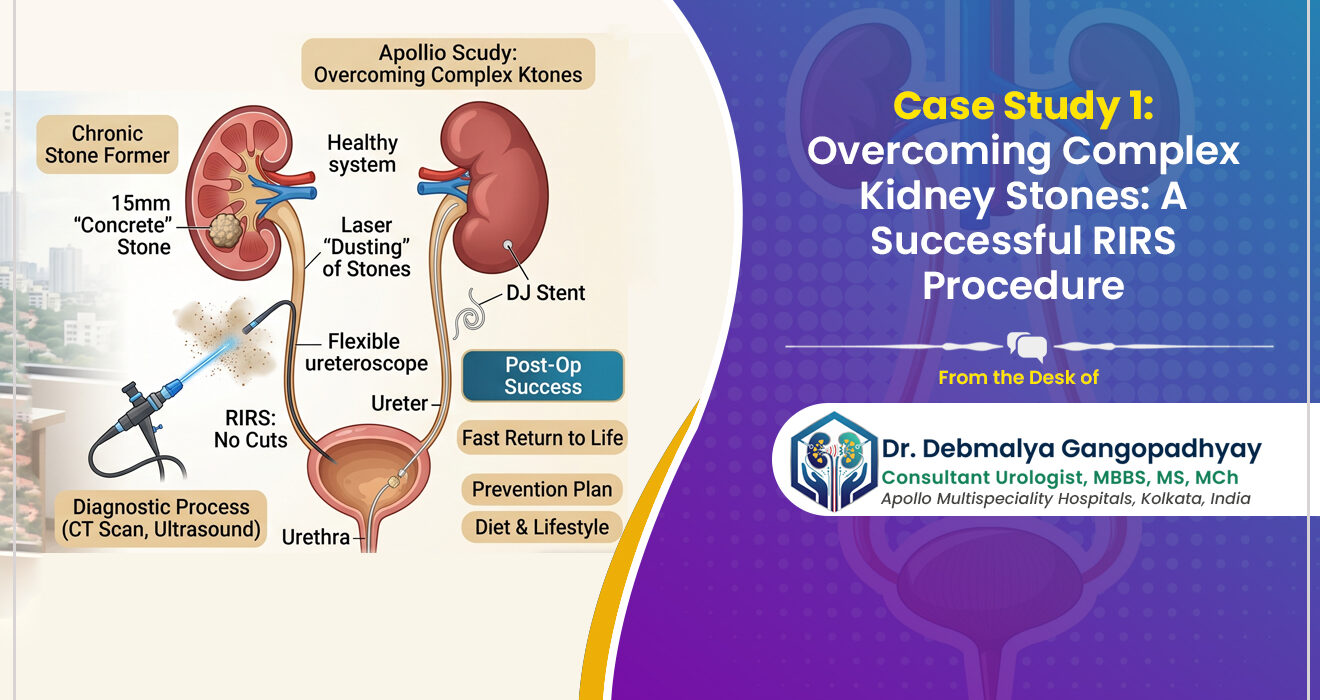
Case Study 1: Overcoming Complex Kidney Stones-A Successful RIRS Procedure
Table of Contents
Toggle‘Case Study 1: Overcoming Complex Kidney Stones-A Successful RIRS Procedure‘ – from the desk of Dr. Debmalya Gangopadhyay, Senior Consultant Urologist, Apollo Multispeciality Hospitals, Kolkata, India
Welcome: A Doctor’s Note on Ending the Pain of Kidney Stones
Hello, and welcome to my clinic’s digital desk. As a Senior Urologist working at Apollo Multispeciality Hospitals here in Kolkata, I meet hundreds of people every year who are suffering from the exact same problem: kidney stones.
If you have ever had a kidney stone, you already know the truth. The pain is terrible. Many of my patients tell me that a kidney stone attack is worse than a broken bone, worse than a bad toothache, and sometimes even worse than giving birth. The pain starts in your lower back, shoots down to your stomach, and makes you feel so sick that you cannot stand up.
But there is another kind of pain that kidney stones cause. It is the mental stress. It is the fear of not knowing when the next attack will happen. Will it happen at work? Will it happen on a family vacation? This fear stops people from living their normal lives.
For many years, fixing a large kidney stone meant a big, scary surgery. It meant doctors had to make long cuts on your back or stomach. It meant staying in the hospital for a week or more, taking heavy painkillers, and staying in bed for a month to heal. Because of this, many people are terrified of visiting a kidney doctor. They try to suffer in silence or try home remedies that sadly do not work for large stones.
I am writing this article to share some wonderful news with you: Those scary days of big, painful cuts are mostly over.
Thanks to amazing new technology, we can now use tiny, flexible cameras and fine laser beams to turn big kidney stones into dust, completely from the inside of your body. No cuts. No stitches. No scars. You can often go home the very next day.
To help you understand how easy and safe this is, I am sharing a real story from my clinic. This is a step-by-step case study of a patient who had a very large, very stubborn kidney stone. By the end of this story, you will see exactly how we fix this problem using natural, scar-free methods.
If you or a loved one are suffering from stone pain and want to explore safe, advanced options, understanding Laser Kidney Stone Surgery (RIRS/PCNL) in Kolkata, Kidney Stone Doctor in Kolkata is the very first step toward getting your life back. Let’s walk through this journey together.
Patient Background and Initial Assessment
Every medical case is more than just an x-ray or a lab report. It is a story about a human being. We don’t just treat the stone; we treat the person whose life has been stopped by the stone.
Meeting the Patient
Let me introduce you to “Mr. Arindam” (I have changed his real name to protect his privacy). Arindam is a 45-year-old man living in Kolkata. He is a hard-working manager at an IT company, a loving husband, and a busy father of two teenagers.
His Daily Struggle and Pain
For the last five years, Arindam’s life was completely controlled by his kidneys. He was what doctors call a “chronic stone former,” meaning his body kept making kidney stones over and over again.
In the past, he had managed to pass a few small stones (about the size of a grain of rice) in his urine while at home. When I asked him what that felt like, he gave a harsh laugh and said, “Doctor, it felt like I was trying to pee out broken glass.” It was a terrible experience, but he survived it.
Three years ago, he had an 8-millimeter stone (about the size of a green pea). A different doctor tried to break it using a machine from the outside that sends shockwaves into the body to crack the stone. While it partly worked, it took three painful sessions, left his back heavily bruised, and gave him terrible anxiety about hospital treatments.
The Big Attack that Brought Him to Me
Arindam’s current nightmare started on a regular Tuesday afternoon. He was sitting in his office leading a very important project meeting. Suddenly, out of nowhere, a blinding, sharp pain exploded deep in his right lower back.
He described it to me as feeling like someone had stabbed a hot knife into his back and was twisting it. The pain shot down into his groin area. He broke out in a cold sweat, his stomach turned upside down, and he began vomiting violently. He literally collapsed onto the floor of his office. His coworkers rushed him to a nearby emergency room where doctors gave him strong painkiller injections just so he could breathe normally again.
As soon as he was stable, he booked an appointment with my clinic at Apollo.
My First Meeting with Arindam (The Initial Assessment)
When Arindam walked into my consulting room, he looked exhausted. He was holding his right side and walking very carefully. He told me he was noticing blood in his urine, he felt tired all the time, and his back constantly ached.
But more than physical pain, Arindam was stressed.
“Dr. Gangopadhyay,” he said, “I am so tired of living in fear. But I am also terrified of surgery. I have a major project at work. I cannot afford to take a month off to recover in a hospital bed. I do not want anyone cutting my back open. Please tell me there is a way to fix this without a big surgery.”
He specifically asked for a solution that was “scarless.” He wanted to be fixed from the inside, using the body’s natural openings, so he could get back to his life and his family as quickly as possible.
During my physical check-up, I gently tapped on his right lower back, and he jumped in pain. His heart was beating fast because he was so worried. I sat him down, gave him a glass of water, and promised him that we would figure out exactly what was going on, step by step, without rushing into anything scary.
Diagnostic Process and Confirmation
Before we can fix a problem, we need to know exactly what the problem is. I never guess when it comes to my patients’ bodies. To give Arindam the safest and best treatment, I needed a perfect map of his insides. I needed to know the exact size of the stone, exactly where it was hiding, and exactly how hard it was.
Here is how we found out, using simple and painless tests.
Step 1: The Basic Checks (Blood and Urine Tests)
Think of your kidneys as two fantastic water filters. Their job is to clean the waste out of your blood and turn that waste into urine. If a stone blocks one of the filters, the dirty water backs up, and the filter gets stressed out.
- Checking the Urine: I asked Arindam for a urine sample. We tested it in the lab and found microscopic drops of blood. This is totally normal when you have a stone because the stone has sharp edges that scratch the inside of the kidney. More importantly, the test showed he did not have a severe bacterial infection. This was great news, meaning it was safe to treat him.
- Checking the Blood: We did a simple blood test to check his “kidney function.” This tells me if his kidney filters are working well or if they are choking. His numbers were a little high, which told me the stone was blocking the flow of urine, causing a backup of pressure. We needed to act before his kidney got tired and permanently damaged.
Step 2: A Quick Look Inside (The Ultrasound)
Next, we did an ultrasound. This is a very simple, painless test where a doctor rubs some warm gel on your belly and back and uses a small wand to take a sound-wave picture of your insides. It takes about five minutes.
The ultrasound showed that his right kidney was swollen like a water balloon. Why? Because a big stone was blocking the exit pipe. The ultrasound showed us the shadow of the stone, but an ultrasound is like looking at a blurry, grainy photograph. I needed a crystal-clear, high-definition picture.
Step 3: Finding the Exact Problem (The CT Scan)
To get the perfect map, I sent Arindam for a special CT scan (Computed Tomography scan). It is completely painless; you just slide into a large donut-shaped machine for a few minutes. We didn’t even need to give him any injections for it.
When I looked at Arindam’s CT scan on my computer, the mystery was entirely solved. Here is what the “map” showed us:
- A Massive Stone: The stone was huge. It measured 15 millimeters To give you an idea, a 15mm stone is bigger than a large marble or a shelled peanut. The tube that carries urine out of the kidney is only about 3 to 4 millimeters wide. This meant there was absolutely zero chance this stone was ever going to pop out on its own. It was completely stuck.
- A Bad Hiding Spot: Kidneys have different “rooms” inside them. Arindam’s stone was sitting in the very bottom room of the kidney (doctors call this the lower pole). This is the absolute worst hiding spot. Because it is at the bottom, gravity keeps it down. Even if the stone broke into small pieces, those pieces would just sit at the bottom like heavy sand in a bucket. They wouldn’t float up and out easily.
- Hard as Concrete: The CT scan machine is so smart that it can tell me how hard a stone is before I even touch it. Arindam’s stone got a very high “hardness score.” It was made of calcium, and it was practically as hard as a piece of concrete or bone.
The Final Confirmation
I called Arindam into my office and showed him the 3D pictures.
“Arindam,” I said, “You have a 15-millimeter stone that is as hard as a rock, sitting in the very basement of your kidney. It is blocking the flow, and it will not pass by drinking water or taking medicine. We have to take it out.”
Line of Treatment
Now came the most important conversation. How do we get a 15mm concrete-hard rock out of the basement of a kidney without making big cuts?
I like to sit with my patients, explain all their choices like we are friends talking over a cup of tea, and pick the best one together.
Talking About the Options We Did NOT Choose:
- The “Keyhole” Surgery (PCNL): I told Arindam about a surgery where we make a small hole (about the size of a pen) directly into his back to reach the kidney and vacuum the stone out. It is a fantastic surgery for massive, giant stones. But Arindam looked at me and said, “Doctor, please, no cuts if possible.” Since his stone was 15mm (large, but not massive), I agreed that we could try something even gentler.
- The “Shockwave” Machine (ESWL): Arindam remembered his treatment from three years ago and asked, “Can we just use the machine that thumps my back from the outside?” I shook my head and pointed to his scan. “Your stone is as hard as concrete, and it is hiding at the very bottom of the kidney. If we try to crack it from the outside, it will just bounce the shockwaves off, bruise your kidney, and cause you a lot of pain for nothing. It will fail.”
The Winning Choice: Laser Surgery from the Inside (RIRS)
I smiled and told Arindam I had the perfect solution for him. It is called Retrograde Intrarenal Surgery, or RIRS for short.
I explained it to him in plain, simple English:
- “Retrograde” just means we go backward, moving up the natural path where urine flows down.
- “Intrarenal” just means we do all the work completely inside the kidney.
“Arindam,” I said, “I am not going to use a knife. I am not going to make a single cut on your skin. I am going to use a tiny, smooth, soft camera that is thinner than a drinking straw. While you are sleeping, I will gently slide this tiny camera up through your natural urinary opening, up through your bladder, and straight into your kidney.”
“This camera is a masterpiece of technology. The tip of the camera can bend and look in any direction, like a snake. I can steer it right down into the basement of your kidney where the stone is hiding. Once I am staring at the stone on my TV screen, I will slide a tiny laser wire through the camera. I will turn on the laser, and it will melt your hard stone into a cloud of fine, soft dust. Then, that dust will just wash out of your body naturally when you pee over the next few days.”
Why Arindam Loved This Plan:
- No Cuts, No Scars: It was exactly what he begged for. Not a single stitch on his body.
- No Big Hospital Stay: He would only need to stay in the hospital for one night.
- Fast Return to Work: He could go back to his IT office job in just two or three days.
Arindam took a deep breath. The fear in his eyes melted away. He understood the plan, he trusted the technology, and he was ready to get his life back. We booked the surgery for the following week.
The Step-by-Step Surgery (The RIRS Procedure)
I know that the idea of going into an operation theater is scary for anyone. You wear a hospital gown, you see bright lights, and you hear beeping machines. But I want to show you exactly what happens while you are asleep, so you realize how smooth, safe, and controlled this process is.
Here is exactly what we did for Arindam on the morning of his surgery.
Step 1: Getting Ready and Falling Asleep
Arindam came to the hospital in the morning on an empty stomach. The nurses were kind and got him settled into a comfortable bed.
The first person he met in the surgery room was my anesthesiologist—the “sleep doctor.” For a laser surgery inside the kidney, the patient must be completely, deeply asleep (General Anesthesia). Why? Because I am going to fire a powerful laser just millimeters away from delicate kidney skin. If the patient coughs, moves, or even takes a really deep breath, the kidney moves. I need the kidney to stay perfectly still. The sleep doctor gave Arindam some medicine through an IV in his hand, and within ten seconds, Arindam was peacefully asleep. He felt absolutely no pain.
Step 2: Creating a Safe Path
Once Arindam was asleep, my work began.
I started by gently inserting a tiny camera into his bladder through his natural urinary opening. I found the little hole that leads up to the right kidney. Think of the kidney like a water tank on the roof, the bladder like a bucket on the ground, and a small pipe connecting them.
First, I slid a very soft, smooth guide-wire up this pipe. Think of this wire as a tiny railway track. Over this track, I slipped a “safety tube.” This thin plastic tube protects the walls of his body from getting scratched by my instruments and lets me continuously pump clean, sterile water into the kidney to wash it while I work.
Step 3: Driving the Tiny Camera to the Stone
Now it was time for the star of the show. I picked up my Flexible Digital Ureteroscope.
This instrument is amazing. It looks like a long, thin, black wire, but it actually has a high-definition digital camera and a bright LED flashlight built right into its tip!
While looking at a large, flat-screen TV monitor, I drove this flexible camera up the safety tube and entered the main room of his kidney. I used a small lever on the handle to bend the tip of the camera downward, navigating through the dark, fleshy tunnels of the kidney until I reached the “basement” room.
And there it was. On my TV screen, the 15-millimeter, ugly, jagged, brown rock was glaring back at me. We had found the enemy.
Step 4: The Magic of Laser Dusting
I cannot pull a 15mm rock out through a narrow pipe. If I did, I would tear the pipe. And I didn’t want to just break it into large chunks, because then Arindam would have to painfully pass those chunks later.
Instead, I used a high-tech Holmium Laser.
I slid a tiny laser wire (as thin as two pieces of human hair) through the camera until the tip of the laser touched the stone. I stepped on a foot pedal, and the laser started firing rapidly.
Instead of blowing the stone up, the laser gently “dusted” it. On the screen, it looked like melting ice. The bright blue laser light hit the hard concrete stone, and layer by layer, the stone simply turned into a cloud of fine, snowy powder. Throughout this process, I pumped clean water over the stone to wash the dust out.
It takes a lot of patience to slowly melt a big stone into dust, but after about an hour of careful, steady work, the entire 15mm rock was completely gone. All that was left was microscopic, harmless sand.
Step 5: The “Safety Straw” (DJ Stent)
Before I pulled my camera out, I did one last, very important step.
Because I had been working inside his kidney, his internal pipes might swell up slightly, just like your ankle swells when you twist it. To make sure the pipes stayed wide open so the remaining stone dust could wash out easily, I placed a soft, temporary plastic tube inside him.
Doctors call this a DJ Stent. Think of it as a soft, hollow plastic straw. One end curls up inside the kidney, and the other end curls up in the bladder. It is completely hidden inside the body; nothing hangs outside.
The surgery was over. It took less than 90 minutes. I turned off the cameras, the sleep doctor gently woke Arindam up, and we wheeled him into the recovery room.
Post-Operative Care (The Hospital Stay)
If you have a big open surgery, the first few days are filled with bandages, pain, and difficulty moving. But after a laser surgery without cuts, the recovery feels almost like magic.
The First Few Hours: Where is the pain?
Arindam woke up in his private hospital room. The first thing he did was reach back and touch his side. He looked at his wife in confusion.
“The pain is gone,” he whispered.
The sharp, stabbing, breath-taking pain that had haunted him for months was completely wiped out. All he felt was a dull, heavy feeling in his lower belly, and he felt like he needed to pee very frequently.
I visited him a few hours later and explained that this was entirely normal. The dull ache and the urge to pee were just his bladder feeling the soft plastic “safety straw” (the stent) rubbing against it. I gave him a mild, everyday painkiller pill and a medicine to relax his bladder. Within an hour, he was completely comfortable, watching TV on his phone.
The Next Morning: Walking Out the Door
The very next morning—less than 24 hours after a major medical procedure—Arindam was out of bed. He was walking around his room and eating a normal breakfast of toast and eggs.
His urine looked a little pink, which is completely normal because of the tiny scratches from the stone and the laser dust washing out. Since there were no cuts on his skin, there were no bandages for the nurses to change. There were no stitches to worry about.
I checked his morning blood reports, and everything was perfect.
“You are ready to go home, my friend,” I told him.
I gave him a few very simple rules to follow at home:
- Drink lots of water: He needed to drink 3 to 4 liters of water a day to flush the rest of the stone dust out.
- Take his medicines: Just a 5-day course of basic antibiotics to keep him safe from infection, and a pill to keep his bladder relaxed around the plastic stent.
- Take it easy: He could walk around his house, climb stairs, and do office work on his laptop. But no heavy lifting, no gym workouts, and no jogging until I took the plastic stent out.
With a huge smile on his face, Arindam walked out of the hospital, got into his car, and went home to his family.
Follow-Up and the Final Success
Two Weeks Later: The Check-Up
Exactly 14 days later, Arindam walked into my outpatient clinic for his follow-up. He looked like a brand new person. He was standing tall, smiling, and full of energy.
He told me he had gone back to his IT office job just two days after leaving the hospital! He didn’t even need to take painkillers at home. He mentioned that for the first few days, his urine looked a bit cloudy, like sand was settling at the bottom of the toilet. I smiled; that was the laser dust washing out, just as planned.
We took a quick, simple X-ray in the clinic. I pointed at the screen and showed him the results. The soft plastic stent was in perfect position. And the kidney? It was completely, 100% clean. There was not a single speck of stone left.
Taking Out the Safety Straw (Stent Removal)
The last step was removing the plastic DJ stent. Many patients are nervous about this, but I promise them it is incredibly simple.
We didn’t need a surgery room, and Arindam didn’t need to be put to sleep. Right there in the clinic, I used a numbing gel and a tiny, soft, flexible camera to look into his bladder. I grabbed the bottom curl of the plastic stent with a tiny tool and gently slipped it out.
The whole thing took exactly one minute. Arindam took a deep breath and said, “Wow, that just felt weird for a second, but it didn’t hurt at all!”
Success!
That was it. The journey was over. Arindam was officially stone-free, tube-free, and pain-free. He hugged his wife in my clinic room. The dark cloud of anxiety that had hung over his family for years was finally lifted. He was a healthy man again.
How to Stop Stones from Coming Back (Diet & Lifestyle Tips)
My job as a good doctor does not end when the stone is gone. My ultimate goal is to make sure you never have to see me for a surgery ever again!
Because Arindam’s body liked to make stones, we had to change his body’s chemistry. I sent his stone dust to a laboratory to see what it was made of. It was made of calcium and oxalate, mixed with too much acid from his diet.
I sat him down and gave him a very simple, easy-to-follow plan to stop future stones. If you want to protect your kidneys, you should follow these rules too:
Rule 1: The Water Rule (The Most Important!)
Most stones form because the body is dehydrated (too dry). When you don’t drink enough water, your urine gets dark yellow, concentrated, and thick. The waste products stick together and form rocks.
- The Fix: You must drink enough plain water so that your urine looks pale, almost clear, like water. For most people, that means drinking 3 to 4 liters of water every single day. Keep a water bottle at your desk and sip it constantly.
Rule 2: The Lemon Rule
Nature has given us a magic shield against kidney stones, and it is called Citrate. Citrate is found in lemons, and it physically stops calcium from clumping into stones.
- The Fix: Squeeze fresh lemon juice into your water a few times a day. It is cheap, tasty, and the best natural medicine for your kidneys.
Rule 3: The Salt Rule (Not the Calcium Rule!)
Many people think that because their stone is made of calcium, they should stop drinking milk or eating yogurt. This is a dangerous myth! Your bones need calcium. If you stop eating calcium, your body will actually make more stones!
The real enemy is Salt (Sodium). When you eat too much salt, your kidneys panic and dump lots of calcium into your urine, which causes stones.
- The Fix: Eat normal amounts of dairy (milk, paneer, curd). But strictly avoid extra salt. Stop adding table salt to your food. Avoid very salty snacks like chips, pickles, salted nuts, and fast food.
Rule 4: The Meat Rule
Eating too much animal protein (like red meat, mutton, and rich seafood) puts a heavy load of acid into your blood. This acid makes the urine the perfect environment for stones to grow quickly.
- The Fix: You don’t have to become a strict vegetarian, but try to eat less red meat. Swap it for plant-based proteins like dal, beans, or simply eat smaller portions of chicken and fish.
Six months after his surgery, Arindam came back for a routine ultrasound. He had followed my diet rules perfectly, carried a water bottle everywhere, and cut down on salty snacks. His ultrasound was completely clean. His kidney was perfectly healthy, and no new stones were forming. He had won the war.
Frequently Asked Questions on Complex Kidney Stones with RIRS Procedure
If you are suffering from kidney stones, you probably have a lot of questions. I hear these same questions every day in my clinic. Let me answer them for you plainly and honestly.
What exactly is a Kidney Stone?
Imagine putting a lot of sugar into a small cup of tea. Eventually, the sugar stops melting and sits at the bottom as a solid lump. A kidney stone is the same thing. When your body doesn’t have enough water to melt the waste products in your blood, the waste clumps together into a hard, solid pebble inside your kidney.
Why do kidney stones hurt so much?
The kidney itself doesn’t feel much pain. But when a stone falls out of the kidney and gets stuck in the narrow pipe leading to the bladder, it acts like a cork in a bottle. The kidney keeps making urine, but the urine cannot get out. The kidney swells up like a balloon, and the pipe squeezes violently trying to push the rock down. That pressure and squeezing cause the terrible agony.
Will the Laser burn my insides?
No, absolutely not. The laser we use is incredibly safe and highly controlled. It only melts the hard stone. The laser beam does not travel deep, and because we are constantly flushing the area with water, there is no heat buildup. It will not burn your kidney at all.
How long do I have to keep that plastic tube (stent) inside me?
Usually, the stent stays inside you for 1 to 2 weeks while you heal at home. It depends on how big your stone was. Taking it out is a 1-minute procedure in the clinic that does not require any cuts or anesthesia.
Can I work out at the gym or play sports with a stent inside me?
No. While the stent is inside you, you should live a quiet, calm life. You can walk around the house, go to the office, and do light chores. But if you jump, run, or lift heavy weights, the plastic stent will rub against the inside of your bladder. This will make you feel like you have to pee constantly, it will burn, and you will see bright red blood in your urine. Rest is best.
Can I dissolve my hard stone using Ayurvedic medicine, Homeopathy, or by drinking lots of fluids?
I need to be very honest here to protect your health. About 85% of all kidney stones are made of Calcium. A calcium stone is literally as hard as a rock you find on the street. You cannot dissolve a calcium rock with any medicine, herbal drops, or magic diets. If a stone is tiny (like 3mm), drinking water might flush it out. But if a stone is large (like 10mm or Arindam’s 15mm stone), it is physically impossible to dissolve it or flush it out naturally. You need a doctor to break it.
My friends told me drinking lots of Beer will cure my kidney stones. Is that true?
This is a very common and very dangerous myth. Please do not do this. Yes, beer makes you pee a lot initially. But alcohol actually dries out your body (dehydrates you) over the next 24 hours. Chronic dehydration is the number one cause of kidney stones! Also, beer has chemicals that turn into acid in your body, which makes stones grow faster. Stick to plain water; it is free and the absolute best medicine.
When should I rush to the emergency room for a kidney stone?
You must run to a doctor or hospital immediately if you have:
- Pain so bad that you cannot find a comfortable position.
- Non-stop vomiting so you cannot even keep water down.
- Fever and chills (shivering). This is a massive red flag. It means the blocked urine is infected. This is a life-threatening emergency and needs immediate hospital care.
- Bright red blood with thick blood clots when you pee.
Is the laser surgery (RIRS) painful?
The surgery itself has absolutely zero pain because you are in a deep sleep under anesthesia. You won’t feel or remember a thing. When you wake up, the terrible stone pain will be gone. You will only feel a mild, dull ache in your lower belly for a few days because of the soft plastic stent, which we easily manage with normal pain pills.
How do I know if I need RIRS Laser Surgery or a different surgery?
Every human body is different. If your stone is small to medium-large (up to 20 millimeters), RIRS laser surgery is usually the best, scarless option. If you have an exceptionally massive stone that fills the entire kidney (bigger than 20 millimeters), we might need to do the keyhole surgery on your back (PCNL) to clean it all out quickly. The only way to know for sure is to get a CT scan and sit down with a urologist to look at the pictures together.
A Final Word of Encouragement
If you are reading this and you are in pain, please know that you do not have to suffer in silence, and you do not have to be terrified of the hospital. Medical technology has become remarkably gentle and patient-friendly.
With simple day-care laser procedures, we can remove the rock, remove the pain, and send you back to your family with a smile. Do not let fear hold you back from living a healthy life.
Disclaimer: The medical information, story, and advice provided in this article are meant for easy educational understanding and reading purposes only. This article does not replace an actual visit to the doctor. Every single patient’s body, kidney shape, and health history are completely unique, meaning the exact treatment and recovery can vary from person to person. The story shared is a combined example based on common real-life patient experiences to help show how the surgery works. Always book an appointment and speak directly with a qualified, board-certified healthcare provider or urologist to get an accurate diagnosis and a safe treatment plan made just for you.
Read the other case studies: